
Fandom Uncovers Two Decades of Fan Trends Across Entertainment & Gaming in Celebration of Its 20th Anniversary
Data Details The Impact Technology Has Had on How Fans Watch & Play Across the Entertainment & Gaming Landscape
The Most Popular TV, Movie & Game Wiki Communities from the Past Two Decades are Unveiled
SAN FRANCISCO, CA – October 31, 2024 – Fandom, the world’s largest fan platform, is celebrating its 20th anniversary in October and in honor of this special moment, we’re diving into two decades worth of data to uncover the biggest entertainment & gaming trends over the past 20 years. Fandom has a treasure trove of first-party data that provides unmatched insight into and across the entire gaming and entertainment landscape. Fandom’s heritage and scale provide a unique lens into the evolution of gaming and entertainment over two decades of unparalleled change in the production, distribution and consumption of media.
When Fandom was founded in 2004 by Jimmy Wales & Angela Beesley Starling as a spin-off of Wikipedia, it began as a small but mighty platform fueled by the passion of a core group of fan contributors. With just 1,500 pages, these enthusiasts poured their hearts into creating detailed wikis that explored every corner of their favorite fictional worlds. That niche corner of the internet has since grown into a global phenomenon, now with 350M monthly unique visitors, 250k fan-powered wikis and 50M pages of content across its portfolio of fan-first brands including GameSpot, TV Guide, and Metacritic.
Data Overview
The entertainment and gaming industry has drastically evolved since 2004 and in honor of Fandom’s 20th anniversary, we’re looking back at some of the top fan trends against the background of immense change in the overall media landscape. Our data also unveils a year-by-year breakdown of the most popular wiki communities from the past 20 years across TV, movies and gaming.
Key Takeaways
Technological and Platform Shifts
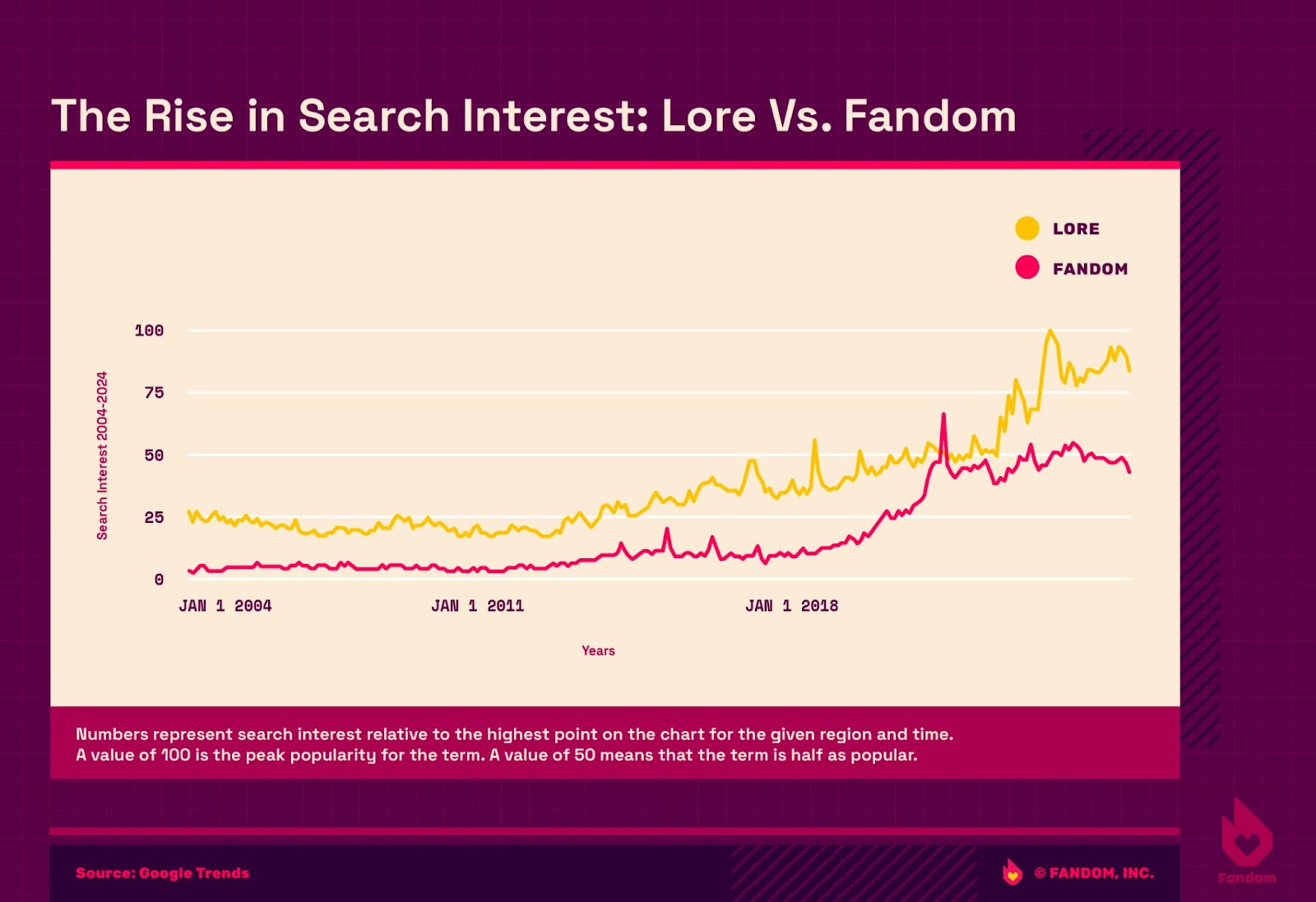
Fan connection with and immersion into the IP they love has grown and evolved over the past two decades. Search interest in terms such as “lore and “fandom” has steadily increased and today over 80% of consumers engage in multiple activities related to their fandoms. Fandom – which enables fans to dive into and celebrate their fandoms – has grown significantly over this time period, fueled by the input and interest of fans.
Simultaneously, the introduction of technology, including smartphones and tablets, has made fan content an “always on” activity. In particular, technology has provided access to more content and information around fandoms, allowing fans to consume it in newer and quicker ways than ever before.
-
Throughout Fandom’s first decade (2004-2014), fans typically did not create or engage with wiki communities about their favorite IP until its release date.
-
Over time and as technology made information more accessible, we started to see consumers leaning into and documenting fandoms much earlier by forming wikis as soon as a show, movie or game was announced.
-
As fan engagement has shifted to digital communities, it’s clear that fans are increasingly eager to create their own content – Fandom now has nearly 100,000 wiki contributors who have made 32 million edits across our wikis this year alone!
Streaming services, most of which launched within the past 5 years, have also had an impact on the content fans consume today:
-
Throughout Fandom’s first few years, the platform’s most trafficked wikis were well-established franchises including Star Wars (created in 1977), Dr. Who (created in 1963), Pokémon (created in 1996) and Harry Potter (created in 1997). These are still relevant today as the rise of streaming services over the past decade have provided both new and old fans increased access to the content they love.
- Today, there’s a proliferation of content across many platforms – streaming services, gaming platforms, YouTube, and influencer channels. And these platforms are home to a much broader array of content – from niche programs to large franchise expansions into other time periods, worlds or content types.
- Game to TV expansions are a hit! Shows such as The Last of Us and Fallout, which are based on popular gaming franchises, have clearly resonated with fans.
-
Fallout, which launched back in 2005, is now the #1 Amazon Prime Video wiki community across Fandom and is also the top gaming community, showing how this IP has grown far beyond gaming thanks to its expansion into new formats.
-
-
Hazbin Hotel, which launched as a YouTube show aimed at a niche audience, debuted on Amazon Prime Video in 2019 and remains one of the top TV shows across Fandom today.
- When looking at the top TV shows/movies from each major streamer across Fandom, it proves the wide variety of content that fans are interested in today:
-
Amazon Prime Video: Fallout
-
Apple TV+: Monarch: Legacy of Monsters
-
Disney+: Star Wars
-
HBO Max: Peacemaker
-
Hulu: The Bear
-
Netflix: Avatar: The Last Airbender
-
Paramount+: Star Trek: Discovery
-
Peacock: Law and Order: Organized Crime
-
- Game to TV expansions are a hit! Shows such as The Last of Us and Fallout, which are based on popular gaming franchises, have clearly resonated with fans.
- The rise of niche streaming services like Crunchyroll have introduced international audiences to local content and fueled the rise of large new genres such as anime. Major streamers like Netflix have also expanded their content to provide larger audiences access to this genre. This growing interest has led to multiple mainstream series and games.
-
Anime is the newest and also fastest-growing vertical across Fandom, growing 608% in the past decade.
-
Netflix became a big name in the anime game, creating popular shows like Terminator Zero, Cyberpunk Edgerunners, Castlevania, and more.
-
Other major streamers like Max, Amazon Prime Video, and Hulu are also expanding their anime libraries, providing more fans accessibility to this genre of content.
-
The rise of multi-platform gaming has made gaming more accessible for a broader range of fans, while the creator economy has fueled more game development and greater game awareness and interest.
-
90% of Fandom’s top games have a PC or mobile version available.
- Platforms like Roblox provided a space for fans to play, create, and interact their gaming experiences, spawning thousands of new games and shifting expectations around the metaverse:
-
Though Roblox was released in 2006, COVID and quarantine boosted its popularity as consumers used it as a proxy for in-person interaction.
-
Today, Roblox games make up 50% of all top trending games across Fandom’s platform including titles like All Star Tower Defense, Tales of Tanorio, and Anime Last Stand.
-
- All of these games and platforms have led to greater engagement and more discussion around gameplay.
-
In fact, Fandom has more than 10,000 Discord servers integrated into wiki communities across our platform, with nearly half of them (47%) being gaming-related. This allows fans to have real-time conversations and discussions about their fandoms on platform.
- Fans have also leaned into gaming influencers to discuss and engage with their favorite games even more. In fact, our wiki communities dedicated to these influencers have drawn over 40 million pageviews in 2024 alone.
-
Popular influencers include Dream Team (2.3 million pageviews), Mr. Beast (1.7 million pageviews), and Pewdiepie (200k pageviews).
-
-
Entertainment & Gaming Acts as a Historian
Mood is the #1 influence on what entertainment & gaming content people are engaging with and fans often turn to these outlets as a way to reflect on or escape from the social and cultural climate around them. By looking at two decades worth of Fandom data, we can see how people felt during certain time periods and how they often leaned into content with thematic elements based on the context of the world around them. Two examples are the financial crisis in 2008 and Covid-19 pandemic in 2020.
2008:
The 2008 financial crisis in the United States was an extremely emotional time with many left feeling anxious, uncertain and angry about the future financial state. To cope during this time, some turned to genres like fantasy and sci-fi to escape into an alternate universe, consuming entertainment and games with thematic elements such as end of the world, dystopia and alternate universes:
-
Movies like Twilight, The Dark Knight, and Iron Man saw spikes in interest among fans during this time, as well as games including Call of Duty and Final Fantasy.
- At the same time, others leaned into content that connected fictional and IRL worlds, engaging with themes of crime, personal growth & reflection and survival:
-
Fans gravitated toward TV shows like Criminal Minds, Law & Order, and Lost. New shows like Breaking Bad and gaming franchises like Grand Theft Auto also kept fans engaged.
-
- On the other end of the spectrum, people often turned to comedy and humor that boasts friendship and teamwork as mental reprieve:
-
Hits like The Office and How I Met Your Mother were popular among fans in 2008.
-
2020:
The Covid-19 pandemic marked a seismic shift in content consumption with 74% of fans spending more time with entertainment & gaming. In early 2020, fans took a literal approach to what was happening around them by consuming virus-related content. As the pandemic continued, they looked for lighter content to laugh and remember the “olden days” as well as content that connected them to the friends and family they weren’t able to connect with in real life.
- During 2020, people were focused on content that incorporated viruses, leading to a +95% increase in traffic to fictional pandemic-related pages including:
-
I Am Legend’s Krippin Virus +246%,
-
Plague Inc.’s Virus Guide +165%,
-
Resident Evil’s Golgotha Virus +62%
-
- As the mass adoption of streaming platforms coincided with the pandemic, audiences leaned into nostalgic favorites that they suddenly had access to, to bring them back to simpler, happier times such as:
-
Gilmore Girls +70%
-
30 Rock +65%
-
One Tree Hill +95%
-
- Consumers also sought ways to connect with others during a time where the world shut down and people were yearning for human connection:
-
There was an +80% increase in consuming entertainment that allowed fans to engage with one another.
-
-
Similarly, data shows a +45% increase in entertainment consumption that allowed people to spend quality time with friends and family.
-
80% of people who watched/played games more with others in their homes were motivated by spending quality time with friends/family.
-
We also saw a +32% increase in experimentation with new types of content, as people watched genres that they had never watched before.
The Top Wikis Shaping Fan Culture Over the Last 20 Years
There have been countless TV shows, movies, games and franchises that have stolen fans’ hearts since 2004 – but Fandom’s data breaks down the communities that fans are still gravitating to the most based on wiki page views today.
Most Popular TV Communities
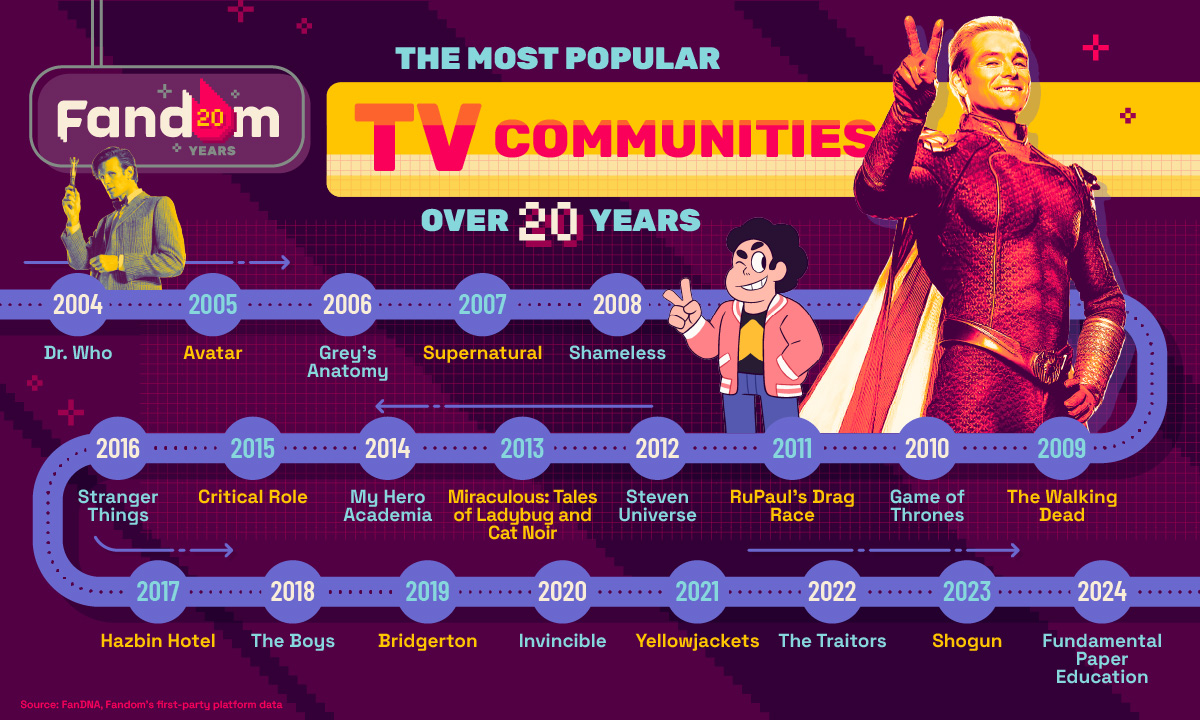
From Grey’s Anatomy to reality TV juggernaut RuPaul’s Drag Race to Yellowjackets and Stranger Things, these are some of the fan-favorite T
V communities over the past 20 years. And most recently, Fandom data reveals a shift towards less traditional entertainment platforms with Fundamental Paper Education, which streams on YouTube, emerging as the most popular show to-date in 2024. Will we see YouTube shows begin to dominate in another 20 years? Stay tuned to find out!
Most Popular Gaming Communities
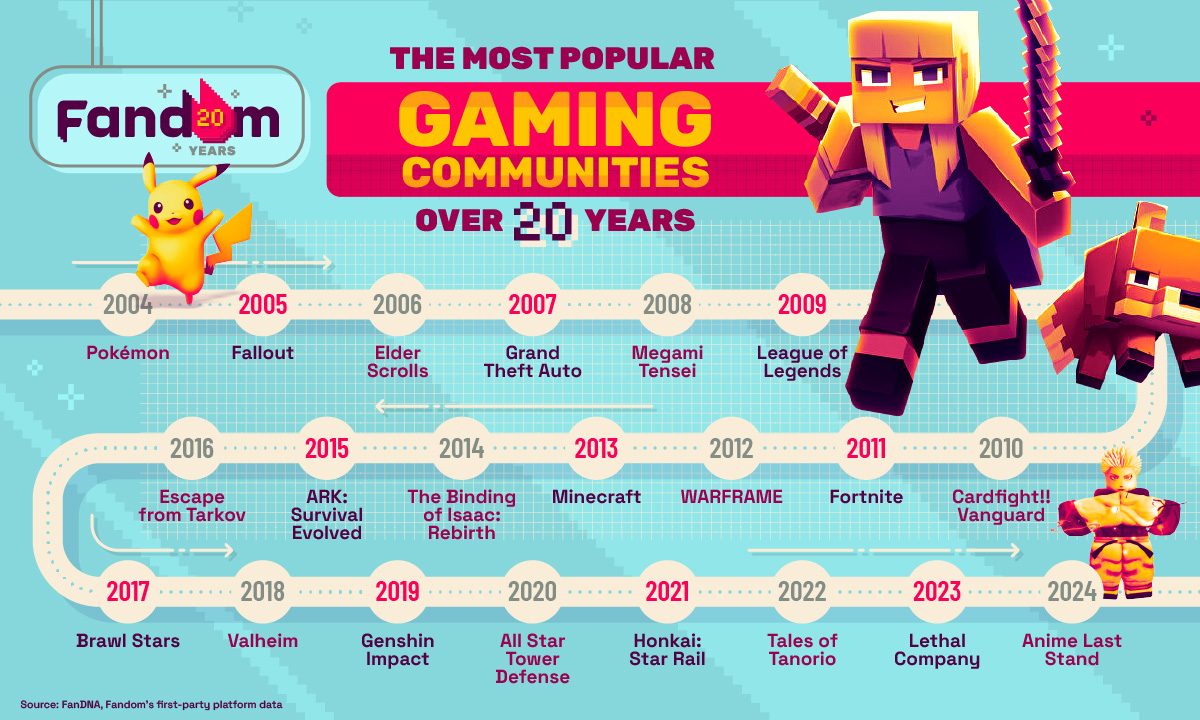
Fandom is a gamer’s best friend! With over 100,000 wiki communities dedicated to gaming, it has organically grown into the largest vertical on the platform today. Throughout the past two decades, fan-favorite games have shifted from well-established franchise titles like Pokémon, Fallout, Elder Scrolls, and Grand Theft Auto, to emerging mega-hits such as Minecraft and Fortnite, and more recently, to UGC games that can be released and instantly go viral, becoming sensations by the next morning on platforms like Roblox. In fact, three of the 20 most popular games are Roblox games, all jumping in popularity after the 2020 global pandemic.
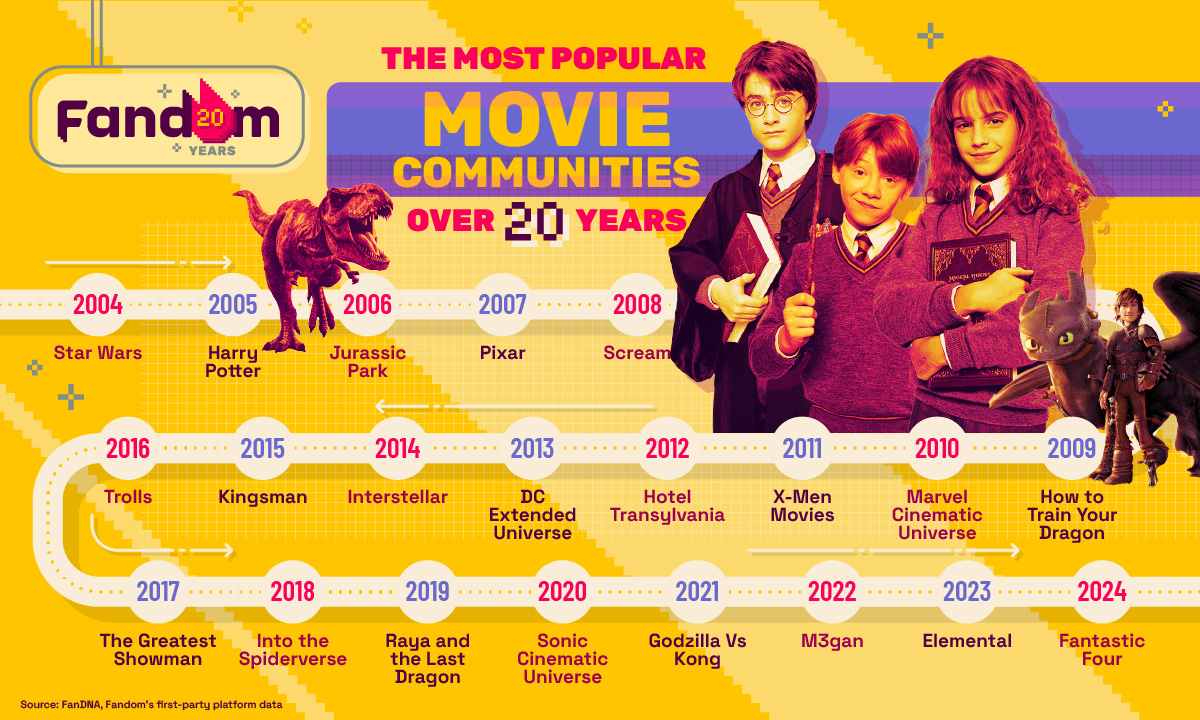
Most Popular Movie Communities
Fandom broke down 20 years of box office buzz to determine the top movie communities that have stood the test of time. Movies from traditional companies like Disney and 20th Century Fox still hold a large spot in fans’ hearts, even as they increasingly engage with digital-first and creator-driven platforms like YouTube. In fact, out of the top 20 movie wikis on our platform, those two studios make up 50% of the top movies wikis alone!
Methodology
Source: FanDNA, Fandom’s first-party platform data
About Fandom
Fandom is the world’s largest fan platform where fans immerse themselves in imagined worlds across entertainment and gaming. Reaching more than 350 million unique visitors per month and hosting more than 250,000 wikis, Fandom is the #1 source for in-depth information on pop culture, gaming, TV and film, where fans learn about and celebrate their favorite fandoms. Fandom’s Gaming division manages the online video game retailer Fanatical. Fandom Productions, the content arm of Fandom, enhances the fan experience through curated editorial coverage and branded content from trusted and established publishing brands Gamespot, TV Guide and Metacritic, along with its Emmy-nominated Honest Trailers. For more information follow @getfandom or visit: www.fandom.com.
Press Contacts
Brenna Harran/(631) 902-9801 or [email protected]